
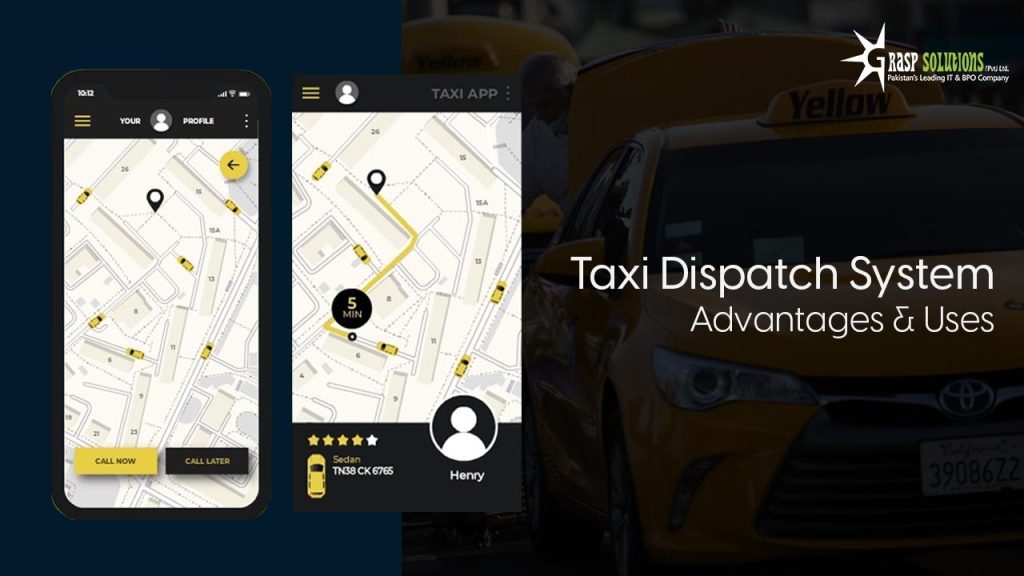
A taxi dispatch system is the software a taxi company uses to take bookings, assign them to drivers and track every trip until it is paid for. It replaces the radio, the notepad and the group chat with one screen that shows every job and every car. This guide explains what a dispatch system is made of, how a booking moves through it, the advantages it brings, what a dispatch desk is trying to achieve, and where people still matter.
What is a taxi dispatch system?
At its simplest, a taxi dispatch system connects three groups: passengers who want a ride, drivers who can provide one, and the dispatchers who run the operation. It records each booking, decides which driver should take it, tells the passenger who is coming, and keeps a record of the trip for billing and reporting.
The main parts of a dispatch system
- Booking channels: phone bookings entered by a call-taker, a passenger app, a web booking form, and account bookings from hotels, hospitals and businesses.
- The dispatch console: the screen dispatchers use to see every job, every driver and the map, and to step in when needed.
- The driver app: receives job offers, provides navigation, and records each stage of the trip.
- Passenger notifications: confirmations, driver details, arrival times and receipts by text or app.
- Billing and reporting: card and cash records, account invoices, driver statements and performance reports.
Types of taxi dispatch
- Radio and phone dispatch: the traditional method, where a dispatcher reads jobs out to drivers. Still used as a backup.
- Computer-aided dispatch: dispatchers use software to record and assign jobs, often with GPS showing where drivers are.
- Automated, app-based dispatch: the system offers jobs to drivers automatically through their app, with dispatchers handling exceptions. Most fleets now work this way.
How a dispatch cycle actually runs
Strip away the branding and every taxi dispatch system runs the same loop. A job arrives, from a phone call, an app booking, a web form or a corporate account. The system geocodes the pickup and works out which vehicles are plausible – free now, or clearing nearby soon. It offers the job, usually to the closest suitable driver first, and waits for an acceptance. Once accepted, the passenger gets a confirmation and an ETA, the driver gets navigation, and the job moves through a series of states: accepted, en route, arrived, passenger on board, completed. At the end it drops into billing, either as a card payment, a cash entry or a line on an account invoice.
The loop is reliable while every step behaves. What decides whether a fleet runs well is the exceptions: a driver who does not accept, an address the geocoder places on the wrong side of a dual carriageway, a flight that lands forty minutes early, an account customer who wants tomorrow’s booking moved while standing in today’s. Software escalates those. It does not resolve them.
What operators are really buying
Most operators comparing dispatch systems are not really comparing features – the core loop above is common to all of them. The real differences are how well the system handles pre-bookings against on-demand work, how account billing is structured, what the driver app does to a driver’s day, and how much of your call volume the platform can absorb before a human has to pick up. That last one is usually underestimated, and it is where the cost of running a fleet quietly lives.
Manual vs automatic dispatch
Automatic dispatch offers each job to the best driver based on distance or estimated time to pickup, zone queues, vehicle type and driver status. It is fast and fair for routine trips. Manual dispatch, where a person chooses the driver, is still needed for wheelchair and group trips, VIP and account customers, long-distance runs and anything unusual. Most companies use automatic dispatch for the bulk of the work and keep a dispatcher on the board for the rest.
Advantages of using a taxi dispatch system
- Faster pickups, because each job goes to the nearest suitable car.
- More bookings taken, from app, web and phone, at any hour, all in one queue.
- Fewer empty miles, which saves fuel and lets each car complete more paid trips.
- Better passenger experience, with confirmations, driver details and live tracking.
- A clear record of every trip, for disputes, lost property, billing and reporting.
- Account and corporate work made manageable, with standing bookings, authorized bookers and monthly invoices.
- Safer drivers and passengers, because the company always knows where each car is.
- Room to grow, because the same team can manage far more vehicles than on paper.
The aims of taxi dispatching, and how to measure them
Whatever system you use, a dispatch desk is working toward the same goals. Each one has a simple number that shows whether you are meeting it.
- Answer every booking: missed calls and average time to answer.
- Short waits for passengers: time from booking to pickup, and on-time rate for pre-booked trips.
- Keep drivers earning: trips per driver per shift.
- Cut empty miles: empty miles as a share of total miles.
- Keep passengers informed: “where is my cab” calls and complaints per hundred trips.
- Fix problems early: late pickups and no-shows, and how many dispatch caught first.
- Keep everyone safe: incidents, and how quickly dispatch responded.
The system is only half of it
A taxi dispatch system automates assignment and tracking, but it still needs someone watching it when a driver cancels at 2am or a rider calls about a booking that has not arrived. That gap is what a staffed desk fills. Grasp Solutions runs taxi dispatch center services with trained human dispatchers, 24 hours a day, working inside your existing system – we staff TaxiCaller and iCabbi among others – so the software has judgment behind it rather than an empty chair.
The same applies to the bigger platforms. Fleets on Autocab get a team that works the booking screen and the dispatch board directly, rather than a separate answering service that emails messages over.
Frequently asked questions
What does a taxi dispatch system do?
It takes bookings from phone, app and web, assigns each one to a suitable driver, keeps the passenger informed, tracks the trip and records it for billing and reporting.
How does a taxi dispatch system choose a driver?
Usually by distance or estimated time to the pickup, combined with zone queues, vehicle type and driver status. Dispatchers can override the choice for special trips.
Does a dispatch system replace dispatchers?
No. It automates routine assignments, but phone bookings, problems and special trips still need a person, especially at night and on weekends.
Which taxi dispatch systems are most common?
Fleets use platforms such as TaxiCaller, iCabbi and Autocab, among many others. The core booking-to-billing cycle is similar across them; the differences are in pre-booking, account billing, the driver app and support.